Shopping Cart
There are no more items in your cart


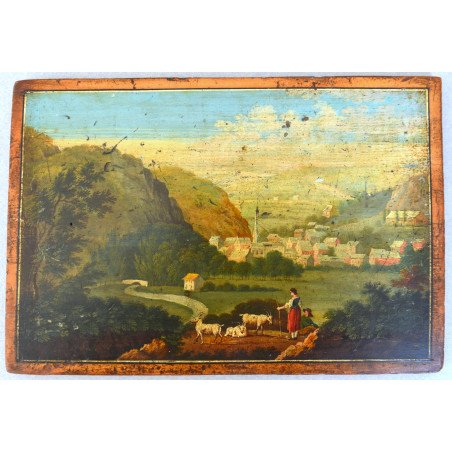
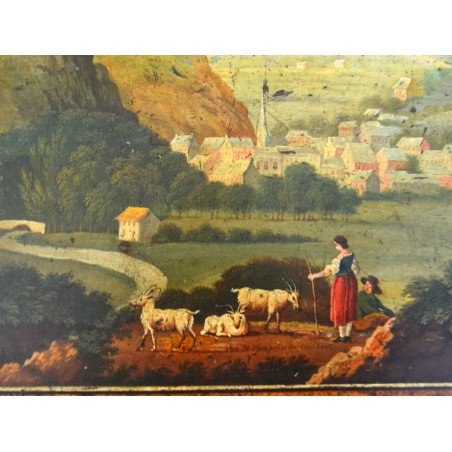
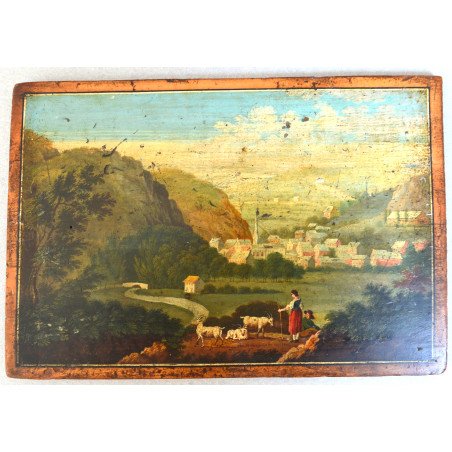


„Vue de Spa prise du couchant” oil on panel, unsigned, Belgium, circa 1840–1860
Panel dimensions 15 × 22 × 0.8 cm.
Oil painting on panel showing a panoramic view of the spa resort Spa, in the province of Liege (Belgium), one of the most renowned European destinations for aristocratic tourism in the 18th and 19th centuries. The original inscription, executed with a brush in the lower part of the composition - „Vue de Spa prise du couchant” ("View of the town of Spa, seen from the west") - explicitly identifies the subject and suggests that the work belonged to the category of topographical vedute intended for travellers and collectors.
The composition is built on the model of the Romantic landscape of Franco-Belgian inspiration. The foreground is animated by a pastoral scene with a shepherdess, a child and a flock of goats and sheep, a motif intended to introduce an idyllic dimension and to create a contrast between quiet nature and the urban settlement in the background. The winding road leads the eye towards the town, dominated by the church spire and framed by wooded slopes, in an aerial perspective characteristic of Romantic vedute.
The palette is bright, with warm tones of ochre, green and blue, and the handling of atmosphere pursues the effects of evening light, as the title indicates. Although the execution is not that of a leading academic master, the painting shows a good command of perspective and a decorative sensibility characteristic of Belgian or French workshops of the mid-nineteenth century.
Historically, representations of the town of Spa circulated widely in the first half of the 19th century, fuelled by the growth of spa tourism. Visitors frequently bought such views as souvenirs, produced both as coloured engravings and as paintings on wood or canvas.
The small size of the wooden panel indicates a work intended for a private interior or a cabinet of curiosities, probably executed in a workshop specialising in the production of views for the tourist market.
The most likely range is 1840–1860, for several reasons:
A slightly earlier date (circa 1835) cannot be ruled out, but after 1870 this type of work becomes much rarer.
Although there are numerous engravings of Spa, original small-format paintings, inscribed and devoted exclusively to this town, are considerably less common. The interest is increased by the fact that Spa is the place that gave its international name to all thermal resorts ("spa").