Shopping Cart
There are no more items in your cart


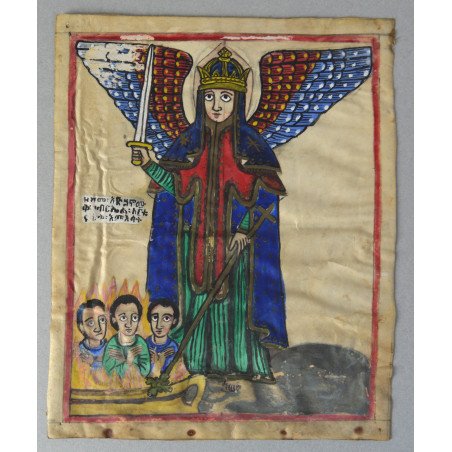


Archangel Michael, tempera and ink on parchment, Ethiopia, 18th-19th century
Tempera and ink on parchment
Dimensions: 30.5 × 25 cm
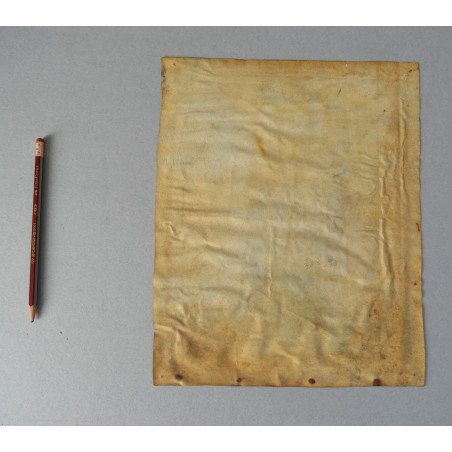
Condition as shown in the photographs: creasing and cockling of the parchment, slight damage at the edges and small losses of the paint layer.
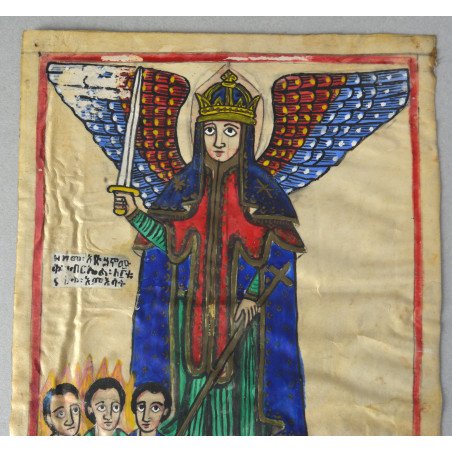
This icon on parchment depicts the Archangel Michael, one of the central figures of Coptic and Ethiopian iconography, identifiable by his raised sword and cross-topped sceptre, symbols of divine protection and heavenly justice. The archangel is shown frontally in a static composition typical of religious art in the Byzantine-Eastern tradition, but with stylistic elements distinctive of Coptic and Ethiopian painting: vivid colours, firm outlines, deliberate disproportion and the hieratic expressiveness of the face.
The ample robes, decorated with star motifs, indicate his status as a heavenly messenger and bearer of the divine will. The wings, treated in alternating bands of red, white and blue, reflect a symbolic colour code particular to Ethiopian religious art, in which blue represents the divine sphere, red the fire of the Holy Spirit and white the light of purity. The golden crown, found in other representations of archangels in Ethiopian manuscripts, suggests his authority over the angels.
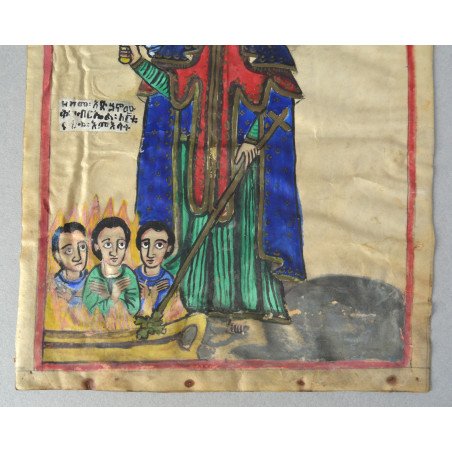
In the lower left corner three human figures are shown surrounded by flames, upon whom Michael appears to intervene with his sceptre. The scene most probably evokes the episode of the three young men in the furnace of Babylon (Book of Daniel 3:19–30), a recurring motif in Coptic and Ethiopian iconography in which the angel of the Lord protects them from the destroying fire.
The story of the three young men cast into the fiery furnace is found in the Book of Daniel, chapter 3, in the Old Testament.
The three young men were:
Shadrach (Hebrew name: Hananiah)
Meshach (Hebrew name: Mishael)
Abednego (Hebrew name: Azariah)
They refused to bow down to the golden image set up by King Nebuchadnezzar, and were for that reason cast into a burning furnace.
According to the biblical account, King Nebuchadnezzar, looking into the furnace, saw four men walking unharmed through the fire. He exclaimed:
"I see four men walking free in the midst of the fire, unharmed, and the appearance of the fourth is like a son of the gods!" (Daniel 3:25 - in some translations)
In the Christian tradition this divine being, the "son of the gods" or an angel, is often identified as an angel of the Lord or, in some readings, as a manifestation of the Son of God (Jesus Christ) before the Incarnation.
Although the story does not explicitly name a particular Archangel as their protector, some Church Fathers and later traditions associated the Archangel Michael with divine intervention in such acts of protection. The original biblical text, however, does not specify the name of an archangel.
The inscription in Ge'ez, set in the left-hand register, confirms the Ethiopian origin of the work and probably serves to identify the sacred figure and the biblical episode depicted.
The icon belongs to the tradition of late Ethiopian religious art, executed on parchment (usually goatskin) and intended both for worship and for private devotion. The technique, the execution and the colour range are characteristic of the monastic workshops active in the 18th and 19th centuries, where Byzantine iconography was reinterpreted through a local filter of strongly naive and narrative expressiveness.