Shopping Cart
There are no more items in your cart






Flemish or Dutch school, early nineteenth century (circa 1800–1835)
Oil on oak panel, unsigned and undated
Dimensions: 16 × 24 × 0,8 cm
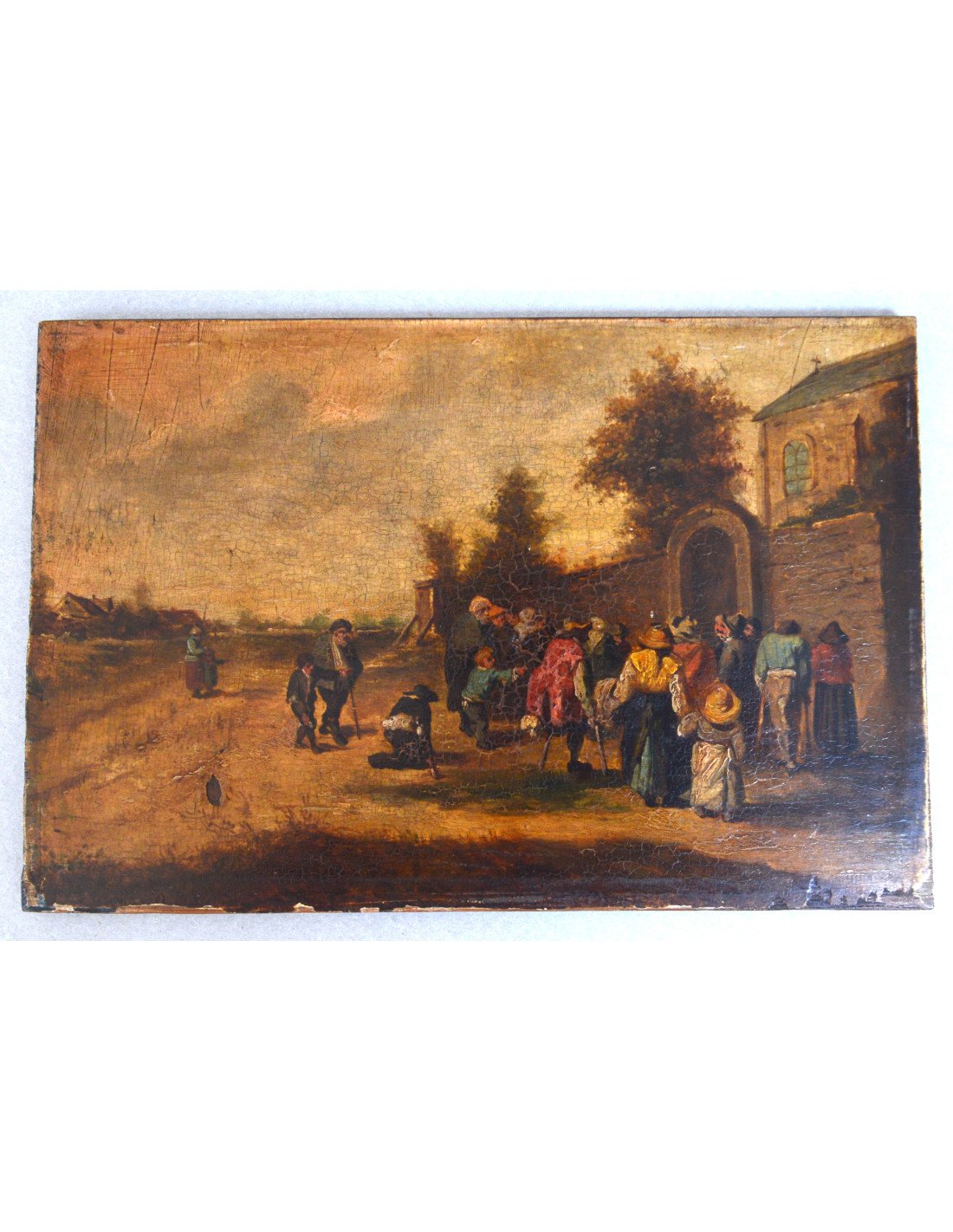
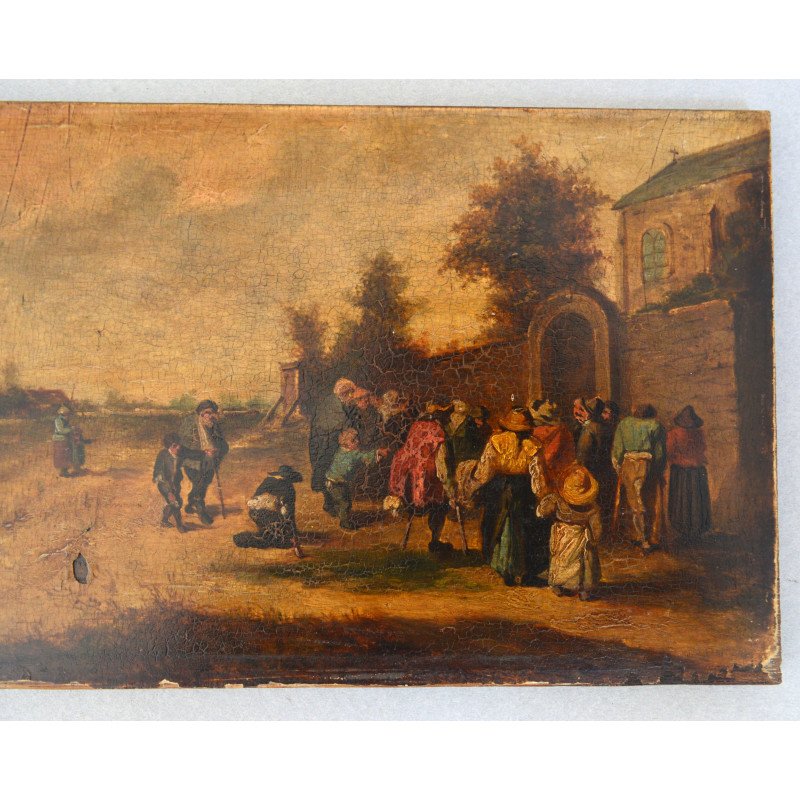
The work is a rural genre scene set in front of a church, showing a large group of figures gathered around the gate of the churchyard. The composition evokes a moment in the daily life of a rural community - most probably the congregation leaving after the service, or a social gathering - a subject frequently found in painting of Flemish and Dutch inspiration.
The compositional structure is balanced and well articulated. The main mass of figures is concentrated on the right, around the church, while the left-hand side opens onto a road that leads the eye towards the distant planes of the landscape. This distribution creates a harmonious dialogue between architecture, landscape and the human figure, giving the work depth and dynamism.
The artist demonstrates a good command of atmospheric perspective and of the organisation of space. The figures, though rendered on a small scale, are individualised through their attitudes and costumes, avoiding the repetitiveness typical of mass decorative production. The palette is dominated by warm tones of brown, ochre and green, enlivened by accents of red and yellow that animate the scene and bring out the groups of figures. The broad sky, modelled through subtle transitions between light and shadowed areas, contributes to the calm, balanced atmosphere of the composition.
Stylistically, the work belongs to the tradition of genre painting cultivated in the Flemish and Dutch world, inspired by the masters of the 17th and 18th centuries but interpreted in a manner of its own belonging to the early 19th century. Although it evokes the rural world characteristic of northern Baroque painting, the execution betrays a sensibility closer to the academicism and early realism of the post-Napoleonic era.
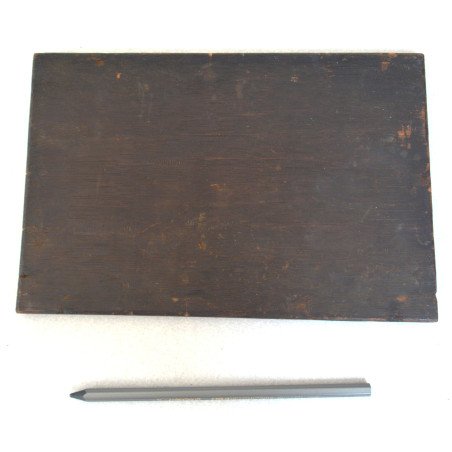
The support consists of a an oak panel made from a single board, of a uniform thickness of about 8 mm. The reverse is smooth, with no obvious traces of machine sawing, and the construction of the panel is consistent with the practices of North European workshops of the late 18th and early 19th centuries. The paint layer shows a natural, stable network of craquelure characteristic of genuine ageing, with no indication of major modern intervention.
In the absence of a signature or of documented provenance, attribution to a specific author is not possible. Nevertheless, the technical level of the execution, the quality of the composition and the choice of support point to the work of a a professional painter, trained in the artistic tradition of northern Europe and most probably active in the first decades of the 19th century.
The work is in good condition for its age. A generalised network of stable craquelure is visible, characteristic of the natural drying of the paint layer, together with small losses of colour and wear at the edges, without major impact on the reading of the composition. The panel shows no visible warping, and the paint film appears well adhered to the support. A slightly yellowed varnish partly dulls the intensity of the colour, so that cleaning and revarnishing by an accredited conservator could appreciably improve the appearance of the work.