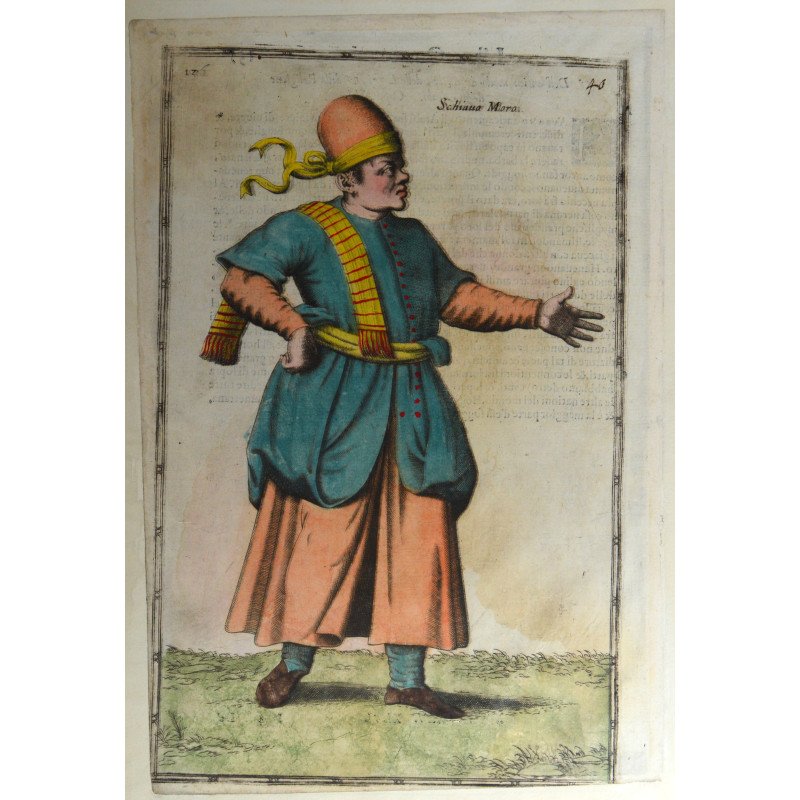
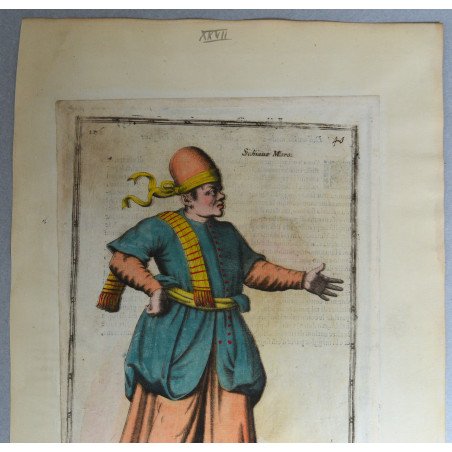
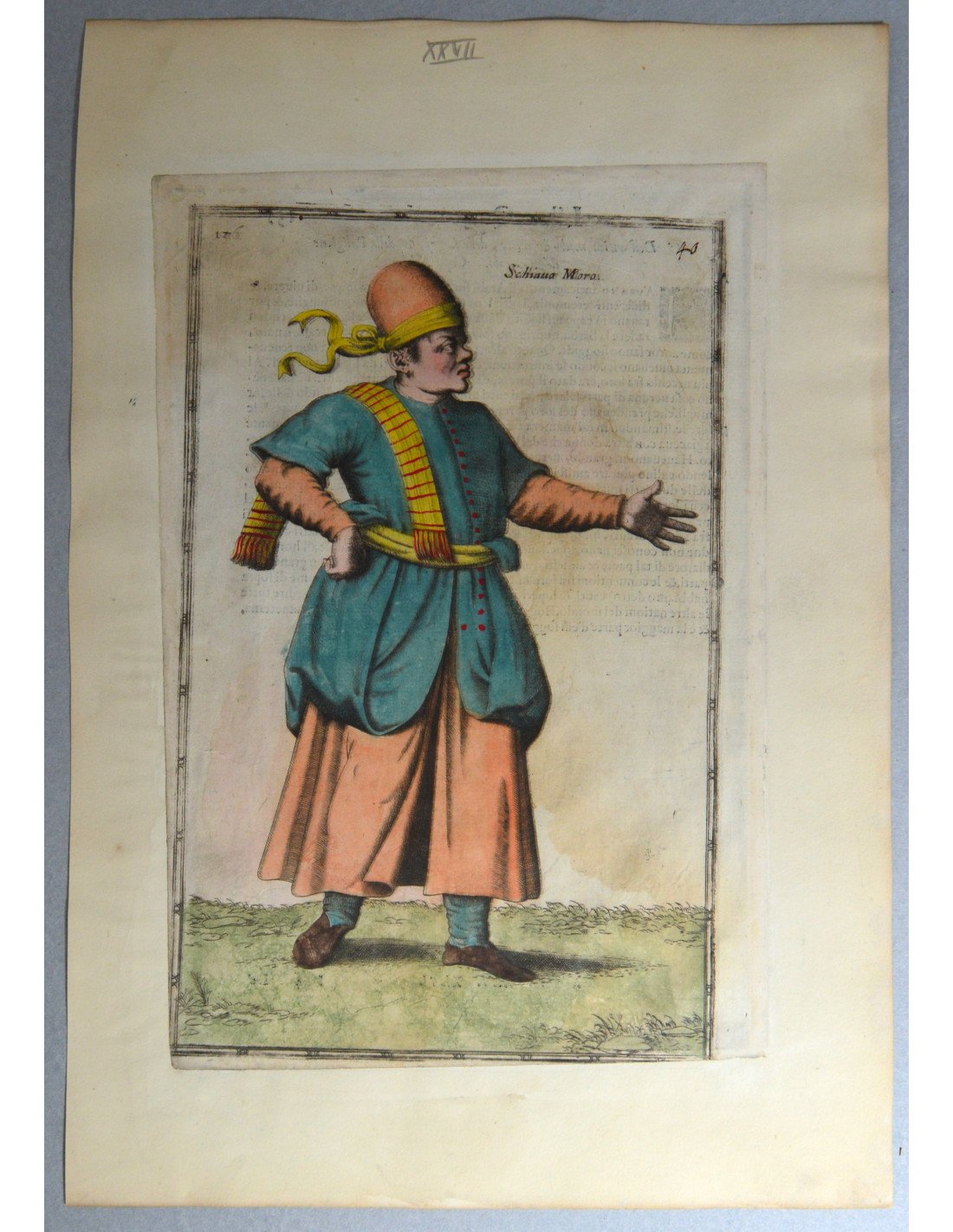
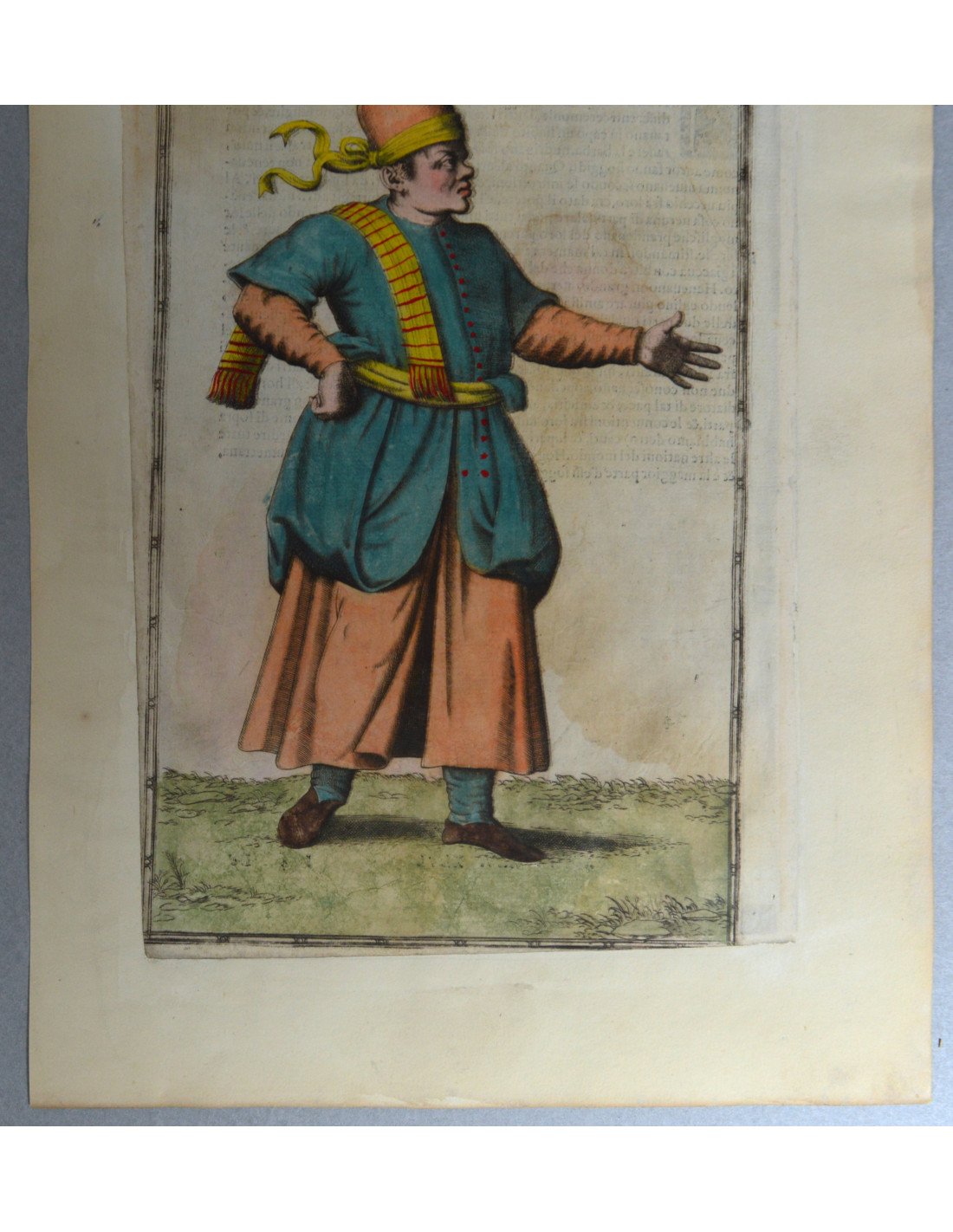
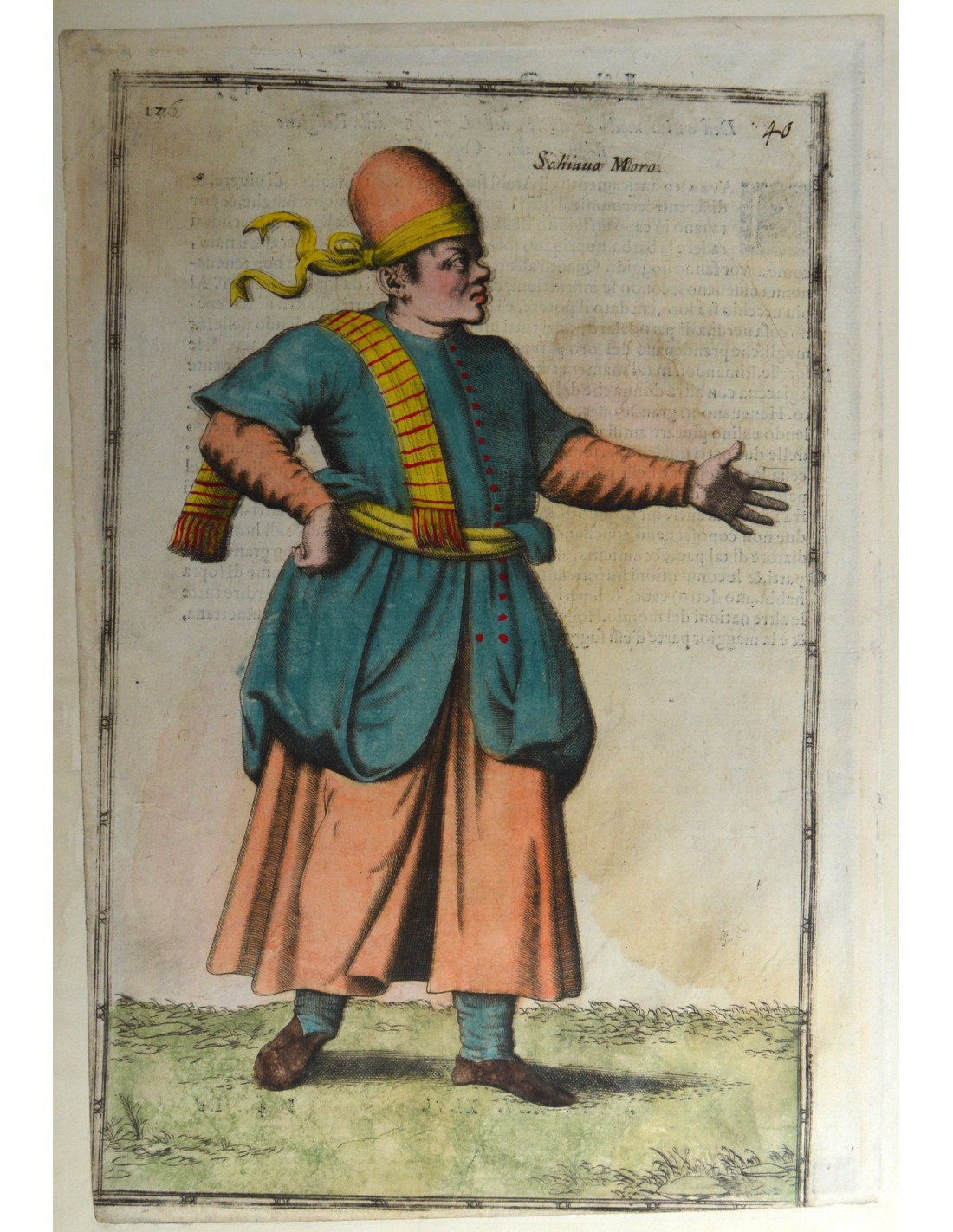
An original Renaissance woodcut entitled „Schiava Mora” („Moorish slave” / „a Moorish woman in servitude”), from the celebrated work by Nicolas de Nicolay "Le Navigationi et Viaggi fatti nella Turchia", printed in the Venetian edition of 1580.
The work belongs to one of the most important Western iconographic corpora devoted to the Ottoman Empire and the Islamic East in the sixteenth century. Nicolay accompanied the French embassy led by Gabriel d’Aramon to Constantinople in 1551, and his observations were first published in French in 1567. The Venetian Italian edition of 1580, translated by Francesco Flori and printed by Francesco Ziletti, is regarded as one of the finest and most complete illustrated editions of the work.
The engraving is executed in relief printing (woodcut), subsequently hand-coloured, probably at the time or very close to it. The figure is shown frontally in orientalised costume, wearing a tall turban and the full garments typical of the Western image of the Ottoman world. Stylistically the image belongs to the tradition of Renaissance ethnographic costume prints, an artistic and documentary genre extremely popular in 16th-century Europe. Such images served to describe visually the peoples, social ranks and ethnic types of the Levant and the Ottoman Empire for a Western public.
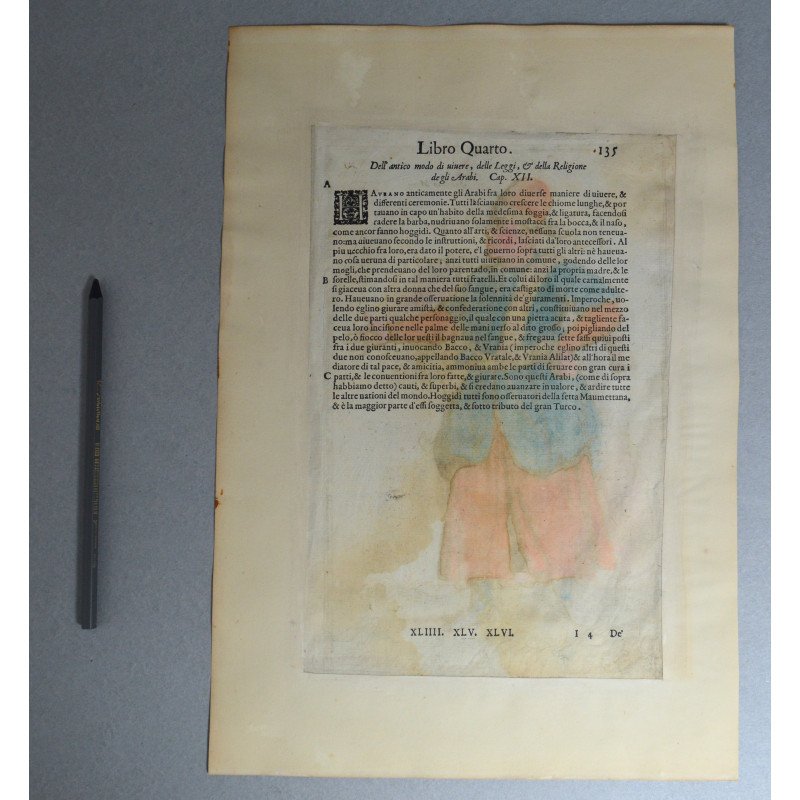
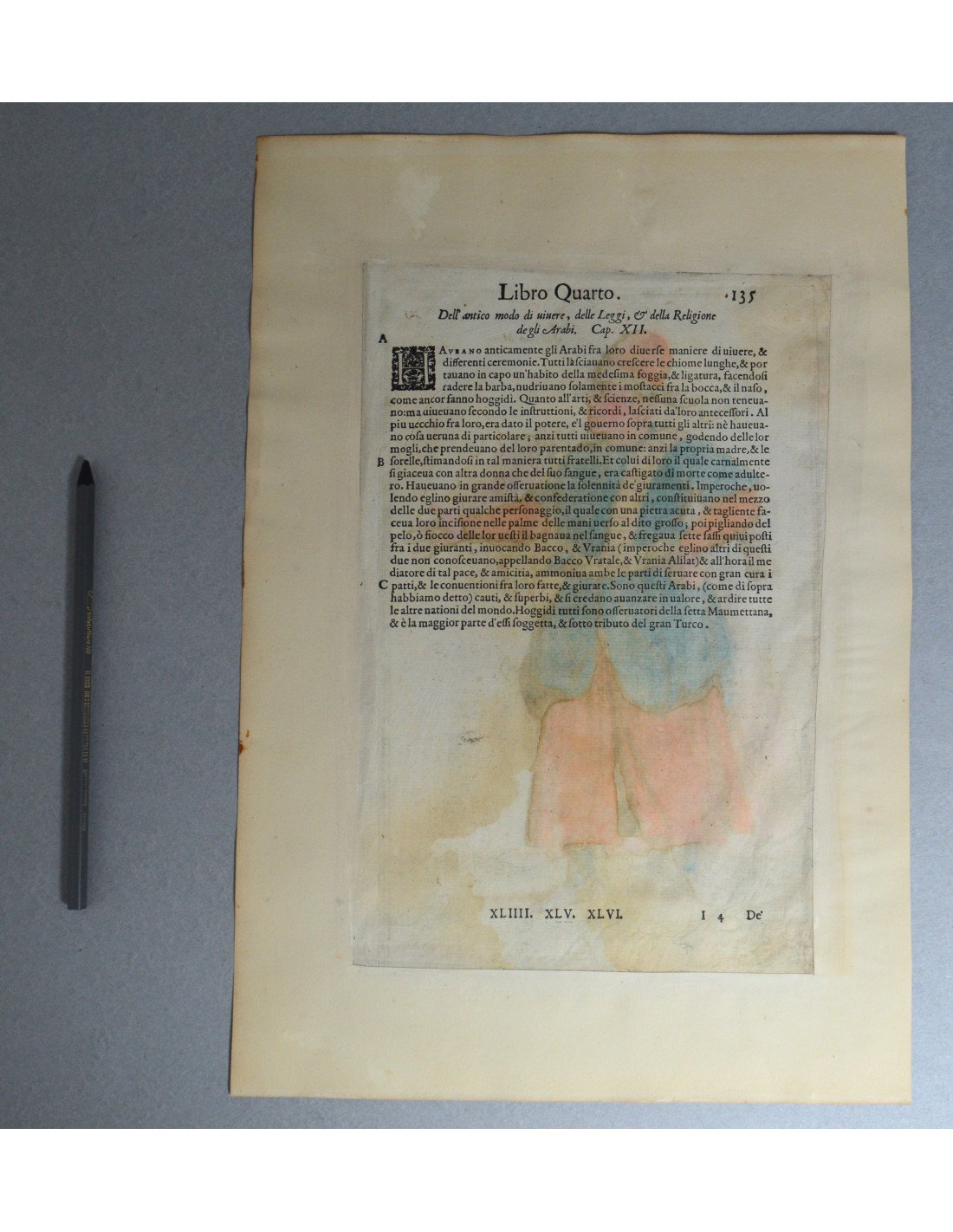
The impression has an element of particular importance for collectors and historians: the original letterpress text printed on the reverse. This confirms that the leaf comes from an authentic copy of the 1580 edition and is not a late decorative impression or a reproduction removed from a modern edition. Page 135 and the typography correspond exactly to the Venetian Ziletti edition.
From a historical and artistic point of view, Nicolay's engravings are considered among the first systematic Western representations of Ottoman society. They profoundly influenced the iconography of European Orientalism and served as a model for numerous later works on Eastern costume and peoples.
„Le nauigationi et viaggi fatti nella Turchia”
translated into Italian by Francesco Flori and printed in Venice by the publisher Francesco Ziletti in 1580.
The evidence leading to this identification:
- the chapter title in Italian:
„Dell’antico modo di vivere, delle Leggi, & della Religione de gli Arabi. Cap. XII.”
- the page numbering and the Venetian typographic style of around 1580;
- the reference to the ethnographic figures („Schiava Moro” etc.) characteristic of Nicolay's illustrated editions.
The image „Schiaua Moro” („Moorish slave / enslaved Moorish woman”) forms part of the series of oriental costumes and ethnographic types included in this work.
Translation
The title:
The fourth book
On the ancient way of life, the laws and the religion of the Arabs. Chapter XII
Translation of the text
„The Arabs formerly had among them different ways of life and different ceremonies. They all let their hair grow long and wore on the head a garment of the same shape and fastening; they let their beards grow but shaved the moustache between the mouth and the nose, as they still do today.
As regards the arts and sciences, they followed no particular school, but lived by the teachings and memories handed down to them by their ancestors.
To the eldest of them was given power and rule over all the others; and they held nothing as personal property but used everything in common, even enjoying their wives in common, whom they took from among their close relatives - even their own mother and sisters, all thus regarding themselves as brothers.
And any one of them who had carnal relations with a woman outside his own blood was put to death as an adulterer.
They attached great solemnity to oaths. When they wished to swear friendship and alliance with others, they placed between the two parties a certain man who, with a sharp cutting stone, made a small incision in the palms of their hands as far as the thumb; then, taking a few strands of their hair or beard, he dipped them in the blood and touched with them the seven stones set between the two who were swearing, invoking Bacchus and Urania (for they knew no gods other than these two), calling Bacchus "Vratal" and Urania "Alilat".
Afterwards, the mediator of that peace and the friends would urge them both to keep with great care the pacts and agreements made and sworn between them.
These Arabs are, as I have said above, prudent and proud, and believe themselves worthier and braver than all the other peoples of the world.
Today they are all observers of the Mahometan faith, and the greater part of them is subject and tributary to the Great Turk."
The text is interesting because it combines:
- genuine observations of the Arab and Ottoman world;
- classical information taken from ancient authors;
- many exaggerations and stereotypes characteristic of sixteenth-century Europe.